Ventures Time: AI News, Companies and Enterprise Solutions
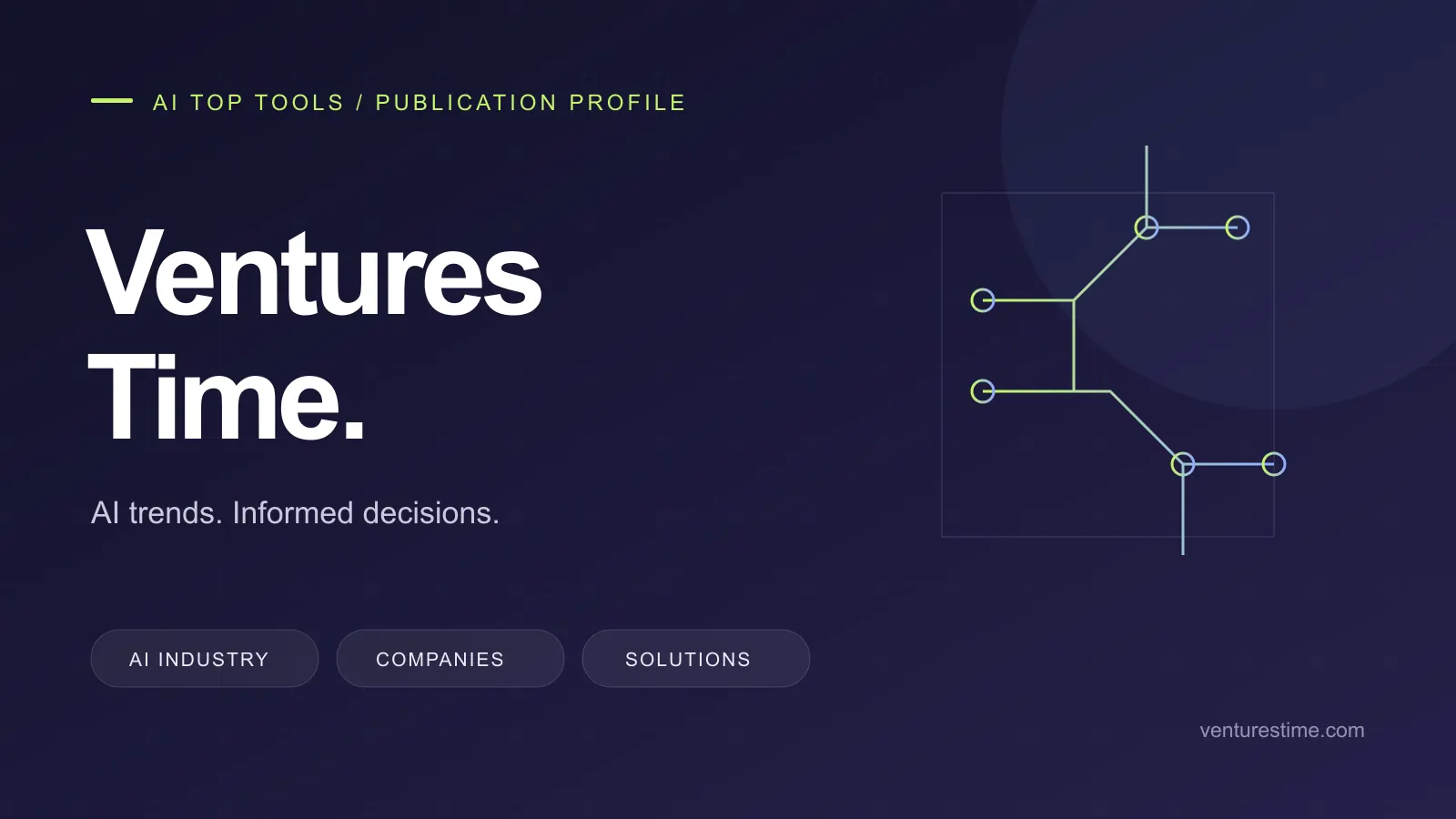
Keeping up with artificial intelligence involves more than collecting product announcements. A new model, an emerging software company or an ambitious automation demo becomes useful when you understand the problem it addresses and the work required to put it into practice. Ventures Time brings that practical perspective to AI industry coverage through original explainers on models, data, security, business and software development.
For AI Top Tools readers, the publication offers a useful companion to tool discovery. Its editorial collection connects important AI themes with questions about implementation, operating costs and results. This profile explores what Ventures Time covers, how it introduces readers to the technical approaches behind prominent companies, and how to use its articles when researching enterprise AI solutions.
What is Ventures Time?
Ventures Time is a technology publication focused on enterprise AI and the systems around it. Its About page describes a collection of original explainers and editorial analysis. The emphasis is on making technical and business decisions understandable: what a system is intended to do, what it depends on, and how a team can judge whether it works.
The publication's editorial policy distinguishes its analysis from interviews, market-event reporting and product testing. Readers can use that distinction to set expectations: a story provides context and a way to think through a development; a purchasing decision still calls for current product information and a trial suited to the intended task.
AI news becomes more useful with context
An announcement can tell you that an AI capability exists. The next questions are often harder: where would it fit in a business process, what information would it need, and how would anyone know that the result was correct? Those are the questions worth carrying from a headline into a project discussion.
Our view is that Ventures Time is useful in this part of the reading process. Its collection follows themes such as agent workflows, model selection, retrieval, governance and evaluation. Reading across these subjects helps connect a visible AI feature with the less visible decisions that support it. That gives readers a more substantial basis for following industry developments and assessing claims about new solutions.
Five connected areas of coverage
The site's sections make it possible to approach AI from several directions:
| Section | Topics to explore | A useful reader question |
|---|---|---|
| AI | Agents, smaller models, open models and document processing | Which approach fits this task? |
| Data & infrastructure | RAG, data contracts, hybrid search and deployment choices | Can the system use the right information? |
| Security | Governance, prompt injection and content provenance | What controls surround the application? |
| Business | AI operating costs and copilot workflows | Does the feature improve completed work? |
| Developer tools | Evaluations, tracing and MCP integrations | How will the team build and assess it? |
These sections also provide a reading path. A product manager researching an assistant can move from model behavior to information quality, then to application controls and operating costs. A developer can start with an engineering problem and follow its implications for the people who will use the product.
Six stories that show the publication's approach
1. Enterprise agents: define the work and its limits
Ventures Time's enterprise AI agents explainer examines the gap between a demonstration and a recurring business workflow. It discusses clearly bounded tasks, permissions, evaluation and recovery, with references to Anthropic's engineering guidance and OWASP. For readers following agent announcements, it supplies a useful set of follow-up questions about what the software can actually do and where a person remains responsible.
2. Smaller models: start with the intended task
The article on smaller models in the enterprise AI stack considers model selection through the demands of a particular workload. Its discussion includes deployment configuration, performance checks and escalation to other models, drawing on Hugging Face documentation. It encourages a more specific comparison than simply choosing the most attention-grabbing model name.
3. RAG: examine the information behind the answer
The RAG source-freshness article looks at ownership, revisions and conflicting material in retrieval systems. Elastic's hybrid-search documentation is among its sources. This is a helpful starting point for readers evaluating knowledge assistants: it shifts the conversation toward which information the application can retrieve, how that information is maintained, and whether an answer can be traced to an appropriate source.
4. AI costs: consider the completed outcome
In its analysis of AI cost per successful task, the publication considers retries, review effort, infrastructure and response-time requirements. It also references NVIDIA's inference-serving documentation. The article gives business readers a way to ask more detailed questions about an AI proposal than the price of an individual model call.
5. Evaluations: decide what an acceptable result means
The guide to evaluating AI around business outcomes discusses task criteria, grading methods and release decisions, with a link to OpenAI's evaluation guidance. Its practical value is in making quality a concrete discussion. A team can use that starting point to decide which errors would prevent launch and which results require closer review.
6. Security: connect inputs with available actions
The prompt-injection explainer examines untrusted material, application permissions and the actions a system can perform. It references OWASP guidance. For a reader exploring an agent or assistant, this adds an essential dimension to feature research: understanding the controls around the application and how those controls can be checked.
Following leading AI companies through their technical approaches
Readers interested in major companies can use these articles as a route into the documentation behind different AI approaches. The reviewed collection includes references to Anthropic on agent design, OpenAI on evaluations, NVIDIA on inference infrastructure, Hugging Face on model deployment techniques, and Elastic on search.
That creates a useful connection between industry names and the problems those organizations address. A reader can follow a source, investigate a technical approach and bring better questions to a product comparison. These references are evidence of the publication's source choices; they do not constitute a league table of companies or a blanket recommendation of their products.
Using the coverage to research AI solutions
Our suggested approach is to turn each article into a short research brief. Begin with one business task, such as helping employees find approved information or preparing a draft that a specialist will review. Describe the input, the expected result and the person responsible for accepting it.
Next, identify the questions a supplier or an internal prototype must answer. The articles above suggest several useful starting points:
- Fit: Which part of the task would the proposed solution handle, and what would remain with the user?
- Information: What sources would it use, who maintains them, and how would changes reach the application?
- Quality: What examples would show an acceptable result, a clear failure and a case that needs review?
- Operation: Who would manage permissions, investigate a problem and decide whether a change is ready?
- Value: What would the complete process cost, including the time people spend checking its output?
Use the same brief for each candidate solution. This gives a comparison a consistent starting point and keeps an impressive demonstration connected to the work you actually want completed. Our guide to planning an AI tool stack offers a complementary way to consider how a new tool would fit with existing choices.
Who may find Ventures Time useful?
Based on the subjects in its collection, we see a useful fit for several groups. Developers can use the engineering explainers to organize technical questions. Product teams can connect a proposed feature with a user task and an evaluation plan. Technology leaders and founders can use the business and infrastructure coverage to prepare discussions about ownership, implementation and operating costs.
Readers newer to AI can also follow a topic across sections instead of learning isolated terms. A question about an assistant can lead naturally into articles about information sources, models, application behavior and quality checks. This is our assessment of the collection's usefulness, rather than a claim about the site's measured audience.
A practical way to follow the site
Start with the Ventures Time homepage, then choose the section closest to your current question. The saved publisher interface includes article search, topic filters, reading times, takeaways and source lists. It also supports a reading list stored in the reader's browser. The RSS feed provides another way to follow published articles.
For a focused reading session, choose one explainer, write down its central question, and follow one primary source. Finish by recording what you would ask a vendor or test in a prototype. Revisit the subject when your project changes. Readers who want a broader framework for interpreting announcements can also explore our article on understanding the real impact of AI news.
Frequently asked questions
Does Ventures Time cover AI news and industry trends?
Its reviewed collection addresses AI industry themes through explainers and analysis, including agents, model choices, retrieval, security and enterprise adoption. Use those articles for context when following developments; the collection does not establish a continuous breaking-news service.
Can the site help me find companies and solutions to investigate?
Yes. Its source links introduce readers to technical documentation from companies involved in models, infrastructure and search. The articles also supply questions for researching solutions. Check current product information and evaluate candidates against your own requirements.
Where can I visit Ventures Time?
Visit www.venturestime.com to explore the publication. Its article links use the canonical venturestime.com domain.
Explore Ventures Time
AI news is most useful when it leads to a clearer question or a better-informed decision. Ventures Time's connected coverage offers a starting point for understanding AI approaches, the companies behind important technical resources, and the practical work involved in choosing a solution. Explore Ventures Time and build a reading list around the decisions that matter to your team.
Review and access note: This profile is based on Ventures Time's saved publisher content reviewed on 17 October 2026. Its production domain presented a Cloudflare sign-in page during verification.
- Posted by
- AI Top Tools Editorial
- Published on
- Category(s)
- AI, Latest Technology