
Revolut Says Self-Hosted AI Cut Its Coding Invoice by 90%
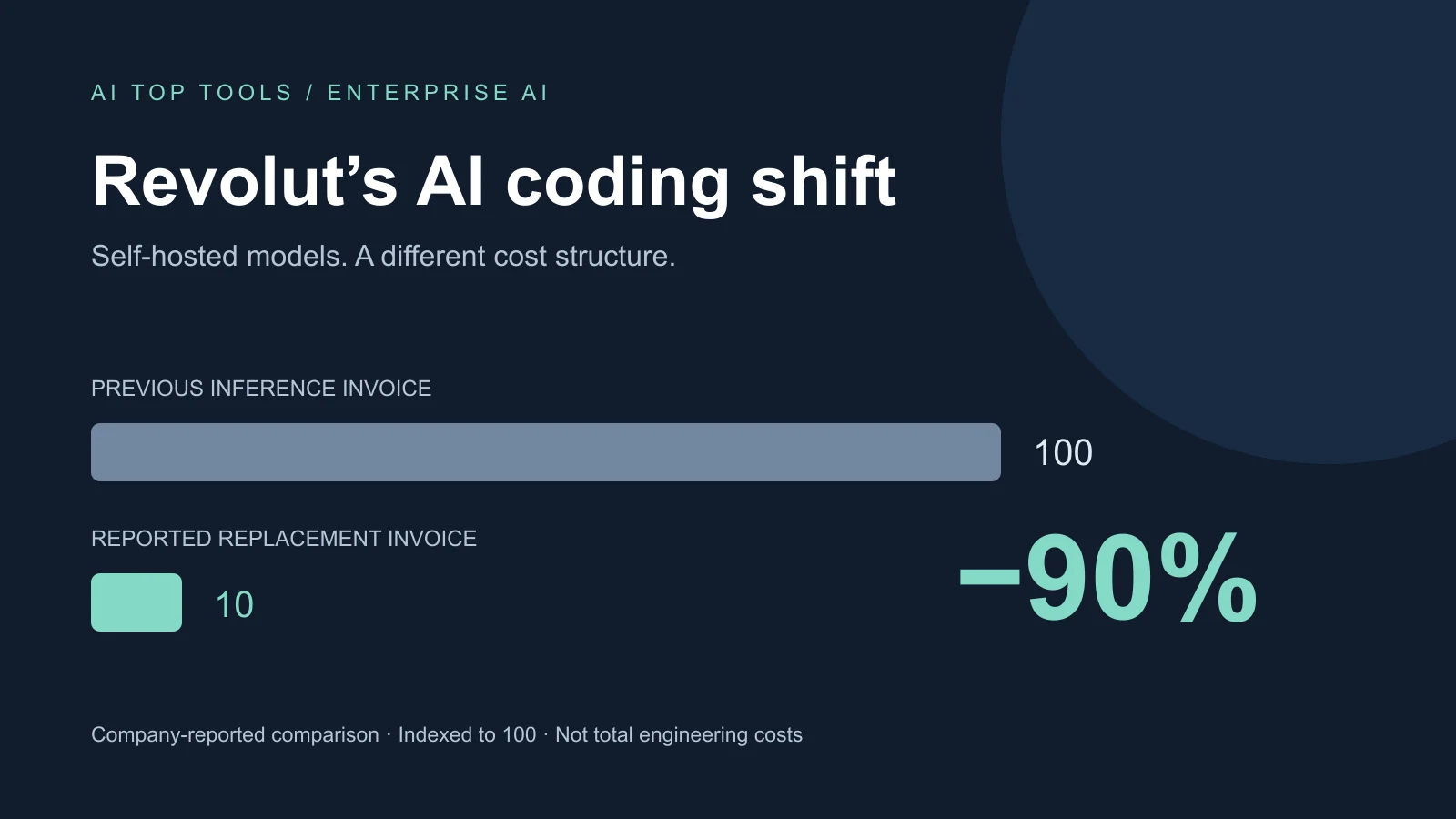
Revolut says it has made self-hosted AI the default for roughly 2,000 engineers and reduced its AI coding invoice by about 90%. The claim points to a different way of budgeting for coding assistants: operate shared inference capacity, then reserve commercial models for work that needs them.
In David Abitbol’s AI Engineer presentation, the Revolut AI operations leader describes GLM models running on approximately 56 Nvidia B200 GPUs. His cost slide lists $0.30 per million input/output tokens, with cache hits free. He compares the invoice with earlier Anthropic and OpenAI spending.
The headline concerns inference spending, not a 90% reduction in the cost of building software. The presentation does not supply a matched-volume cost audit or a complete operating-cost breakdown. The results are company-reported.
Commercial models remain part of the workflow
Abitbol says Revolut still uses Claude Code, Codex and Gemini, while prioritizing open models. He also reports faster coding and delivery, although the talk’s spoken lead-time percentage differs from the slide. Those observations do not establish a controlled productivity benchmark. The conference account preserves that distinction.
For engineering leaders, the useful question is which tasks justify each kind of capacity. A routine change with clear acceptance criteria may deserve a different spending policy from an unfamiliar architecture problem. A useful evaluation would compare completed, reviewed changes across those task types and track how often the default model needs help.
The interface developers use and the service performing inference should also be evaluated separately. Familiar workflows can make an infrastructure change easier to adopt, but each integration still needs validation: tool execution, repository context and error recovery all affect the final result.
What a lower inference bill does—and does not—tell you
A cheaper token is valuable only when it contributes to useful work. If a model needs repeated attempts, produces changes reviewers must rewrite or delays engineers during busy periods, a low serving rate can coexist with expensive delivery. The relevant unit for a team is a successful task at an acceptable quality level.
A fair comparison should therefore include infrastructure charges, platform engineering time, monitoring, upgrades and fallback usage. It should also distinguish the cost of available capacity from the cost of capacity actually consumed. Shared infrastructure has to be funded even during quiet periods; busy periods test whether that same infrastructure provides a usable service.
Here is a hypothetical example, not Revolut’s budget: replacing a $100,000 monthly inference bill with a $10,000 serving invoice would reproduce the headline’s percentage. If operating the replacement added $20,000 of monthly costs, the combined bill would be $30,000. That would still be a substantial saving, but the full comparison would be 70%. The accounting boundary changes the conclusion.
Measure delivery alongside model usage
Teams evaluating a similar move should define success before changing the default. Select a representative group of maintenance tasks, tests, refactors and new features. Compare how much human effort each accepted change requires, how quickly reviewers can understand it and whether defects appear after release. Keep task complexity visible so a shift toward easier work does not look like a model improvement.
Latency deserves its own check. An assistant that works well in an individual trial may behave differently when an entire engineering organization starts using it. Test the busy period, observe waiting time and record failed or abandoned requests. An infrastructure budget should buy a service people can depend on throughout the working day.
Separate coding speed from delivery speed, too. Faster implementation may leave review queues, missing requirements or release coordination as the main constraint. The best next investment could be a better review process rather than more generation capacity.
Control requires an operating owner
Running an inference service creates responsibilities beyond choosing model weights. Assign an owner for availability, access control and upgrades. Decide what repository information may enter prompts, how logs are protected and who can investigate incidents. Treat permission to suggest a command separately from permission to execute it.
For a smaller team, the practical first step is a limited comparison using existing workloads and a defined budget. Estimate total operating costs before committing to dedicated capacity. Keep an escalation path for tasks the default model handles poorly, and review the result after enough real work has passed through the system.
Our reading of Revolut’s reported shift is that model choice is becoming an infrastructure and workflow decision. The attractive outcome is a predictable budget that supports more useful work. Whether self-hosting achieves that for another organization depends on its workload, utilization and ability to operate the service.
Sources and editorial note: Reviewed November 10, 2026. This article follows the Dealroom news item supplied by the reader; that page was inaccessible during checking. Factual reporting was checked against the linked AI Engineer presentation account and conference video source. The cost example and evaluation suggestions are AI Top Tools editorial analysis. We did not audit Revolut’s infrastructure or reproduce its results. Cover: original editorial graphic; the indexed bars illustrate the reported invoice comparison.
- Posted by
- AI Top Tools Editorial
- Published on
- Category(s)
- AI, Latest Technology